
Big Muddy Speaker Series presents:
Reconnecting Rivers and Floodplains - Reconciling Theory & Practice

Presentation by David Galat, PhD, former Professor at University of Missouri Cooperative Fish & Wildlife Research Unit
Original Presentation, July 8, 2015 at Big A’s Restaurant, St. Charles, MO.
The importance of seasonal flooding to reconnect large rivers with their floodplains is essential for their ecological integrity. Due to channelization and levee protection, the Lower Missouri River (LMOR) has been cut off from much of its floodplain.
When it comes to projects attempting to reconnect the river and its floodplain on public lands, there are often conflicts that arise between the theory and actual practice. Dr. Galat’s talk was focused on working to reconcile these difficulties. He shared some of his research on floodplain connectivity in large rivers around the world, as well in the Lower Missouri River.
This presentation specifically covered four topics. First, connectivity and its attributes in large rivers were reviewed. Then, past and present changes in lateral connectivity of the lower Missouri River were described. Next, the importance of lateral connectivity for fish spawning was illustrated for an intensively managed wetland pool at the Eagle Bluffs Conservation Area. To conclude the talk, multiple examples were presented of the enhancement of lateral connectivity along the LMOR through the Missouri River Recovery Program's habitat creation projects.
Meet Your Presenter

David Galat
, PhD, former Associate Professor
Dr. David Galat is a former Associate Professor of Fisheries at the University of Missouri. He is currently a science adviser for the Nature Conservancy's Great Rivers Partnership and has served on the Science Advisory Panel for the Missouri River Recovery Implementation Committee. He is currently trying (and failing) to stay home more with his chickens.
Related Presentations
Resources & Links
Dig deeper for more info on this topic -
- The Nature Conservancy's Great Rivers Partnership - Mississippi River Basin
- PAPER - "Flow and Form in rehabilitation of Large River Ecosystems: An Example from the Missouri River" - by Robert Jacobson, PhD; and David Galat, PhD.
- PAPER - "Hydrologic and geomorphic considerations in restoration of river-floodplain connectivity in a highly altered river system, Lower Missouri River, USA" by Robert Jacobson, Tyler Janke and Jason Skold.
- PAPER - "Missouri River Postflood Evaluation Synthesis" by David Galat and Michael Headrick
- PAPER - "Restoring Ecological Integrity of Great Rivers: Historical Hydrographs Aid in Defining Reference Conditions for the Missouri River" - by David Galat and Robin Lipkin
- PAPER - "Design of a Naturalized Flow Regime" - by David Galat and Robert Jacobson
- PAPER - "River Floodplain Connectivity and Lateral Fish Passage:A Literature Review" by Brian S. Ickes, Jon Vallazza, John Kalas, and Brent Knights
The Big Muddy Speakers Series in St. Charles
is hosted by these wonderful partners:
- Greenway Network
- Missouri River Relief
- Friends of Big Muddy
- Big Muddy Adventures
- Big Muddy National Fish & Wildlife Refuge
- Big A’s Restaurant
All speakers are presenting for free and Big A’s is sharing the space for free! Thank you for sharing your knowledge with all of us!
The Big Muddy Speaker Series also takes place monthly in Rocheport and Kansas City.
A special thank you to Greg Poleski of Greenway Network and Mike Clark of Big Muddy Adventures for making this happen!
Upcoming Presentations

Leave No Trace Training on the Barge
October 14, 2026St. Louis, MO
Join us for a special Big Muddy Speaker Series on the Living Lands & Waters Barge where Perry Whitaker will lead us in a Leave No Trace Training.
See Event
Missouri River Relief: 25 Years on the Big Muddy
November 10, 2026Columbia, MO
Join us for a journey through time celebrating 25 years of Missouri River Relief's work on the Big Muddy.
See Event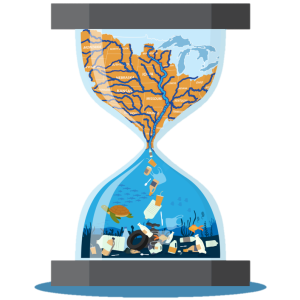
Plastic Pollution, Gulf Hypoxia, and Water Quality
November 11, 2026St Charles, MO
Jennifer Wendt from MidAmerica Clean Future guides us through understanding regional water quality challenges.
See Event